I've been wondering why our local government(s) consistently ask us for money, but rarely, if ever, ask us for our actions? After all, it is our actions (and our thoughts) that are the basis of our democracy, not our money.
Anyone have any thoughts on this?
For instance, we are working with a consortium of local organizations and governments to create an idle-reduction ordinance affecting all vehicles traversing the region. The goal of such an ordinance is to limit the harmful emissions caused by needless idling. This ordinance requests that people in our region 'take the action' of reducing idling by turning off their engine, when waiting for a period of say, 30 seconds or more.
What are some other examples of requesting an action from citizen in our region, as a means of strengthening our city/region?
Monday, December 01, 2008


Saturday, March 22, 2008
Commun
A quick study on the origin of words:
commune
community
communion
communism
communication
all derived from 'common '
1297, from O.Fr. comun, from L. communis "in common, public, general, shared by all or many," from PIE *ko-moin-i- "held in common,"
PIE: Proto-Indo-European, the hypothetical reconstructed ancestral language of the Indo-European family. The time scale is much debated, but the most recent date proposed for it is about 5,500 years ago.
commune
community
communion
communism
communication
all derived from 'common '
1297, from O.Fr. comun, from L. communis "in common, public, general, shared by all or many," from PIE *ko-moin-i- "held in common,"
PIE: Proto-Indo-European, the hypothetical reconstructed ancestral language of the Indo-European family. The time scale is much debated, but the most recent date proposed for it is about 5,500 years ago.
Saturday, December 15, 2007
Cars Are The Problem With Snow
It's cars and snow that don't mix that makes Clevelanders dislike our winter weather. Imagine your favorite neighborhood shopping district, otherwise known as a functioning, lively, and organic neighborhood. Imagine walking down the sidewalk window shopping or bar hopping or friendly talking...... That's a really nice feeling to recall, isn't it?
Now recall that feeling with a gentle breeze and a snow fall. A bit cold around the ears and nose, are ya!? All the more excuse to stop in and say hello to a neighbor merchant and order a cup of joe; retreat for a bit only to gather some steam and plunge back out to the snowy sidewalks of your neighborhood......lights twinkling, beers drinking, community linking.
Now stop thinking of that.
Consider this scene instead. You're driving your trusty steed (your automobile) to your favorite shop/pub/parlor. It's warm and cozy in your car and all is well, though admittedly, it's a bit difficult to see out the window. It's snowing afterall. No matter, you're warm and cozy and speeding along (relatively, it's snowing afterall) to your destination. You wish you could go faster, but alas the roads are slippery and it's hard to see. But wait, there's help around the corner. You see a flashing siren and the the spray of salt comes barreling at your windshield. 'We're saved', you think. Everything's okay - full speed ahead.
And therein lies the problem.
Monday, October 22, 2007
Social Ideology of the Motorcar
I picked up this booklet, written in 1973, at an event celebrating the car-free lifestyle while I was living in Chicago in 2002. It seems that the idea of being car-free is something that is only considered in places that possess lively streets where people really do live, work, and play. Here in Cleveland, I think we are still working on creating those neighborhoods.
But, if we can advance to the time when those neighborhoods are already in existence, we will come to realize that the car is actually a barrier to creating a livable place. And we will begin to advocate for places where cars are simply not allowed.

In order to get you to that frame of mind now, I encourage you to read this manifesto, 'Social Ideology of the MotorCar by André Gorz. I've copied one of my favorite passages below, but you can download the entire manuscript for free, right here.
"The worst thing about cars is that they are like castles or villas by the sea: luxury goods invented for the exclusive pleasure of a very rich minority, and which in conception and nature were never intended for the people. Unlike the vacuum cleaner, the radio, or the bicycle, which retain their use value when everyone has one, the car, like a villa by the sea, is only desirable and useful insofar as the masses don't have one. That is how in both conception and original purpose the car is a luxury good. And the essence of luxury is that it cannot be democratised. If everyone can have luxury, no one gets any advantages from it. On the contrary, everyone diddles, cheats, and frustrates everyone else, and is diddled, cheated, and frustrated in return.
This is pretty much common knowledge in the case of the seaside villas. No politico has yet dared to claim that to democratise the right to vacation would mean a villa with private beach for every family. Everyone understands that if each of 13 or 14 million families were to use only 10 meters of the coast, it would take 140,000km of beach in order for all of them to have their share! To give everyone his or her share would be to cut up the beaches in such little strips-or to squeeze the villas so tightly together - that their use value would be nil and their advantage over a hotel complex would disappear. In short, democratisation of access to the beaches point to only one solution-the collectivist one. And this solution is necessarily at war with the luxury of the private beach, which is a privilege that a small minority takes as their right at the expense of all.
Now, why is it that what is perfectly obvious in the case of the beaches is not generally acknowledged to be the case for transportation? Like the beach house, doesn't a car occupy scarce space? Doesn't it deprive the others who use the roads (pedestrians, cyclists, streetcar and bus drivers)? Doesn't it lose its use value when everyone uses his or her own? And yet there are plenty of politicians who insist that every family has the right to at least one car and that it's up to the "government" to make it possible for everyone to park conveniently, drive easily in the city, and go on holiday at the same time as everyone else, going 70 mph on the roads to vacation spots."
But, if we can advance to the time when those neighborhoods are already in existence, we will come to realize that the car is actually a barrier to creating a livable place. And we will begin to advocate for places where cars are simply not allowed.
In order to get you to that frame of mind now, I encourage you to read this manifesto, 'Social Ideology of the MotorCar by André Gorz. I've copied one of my favorite passages below, but you can download the entire manuscript for free, right here.
"The worst thing about cars is that they are like castles or villas by the sea: luxury goods invented for the exclusive pleasure of a very rich minority, and which in conception and nature were never intended for the people. Unlike the vacuum cleaner, the radio, or the bicycle, which retain their use value when everyone has one, the car, like a villa by the sea, is only desirable and useful insofar as the masses don't have one. That is how in both conception and original purpose the car is a luxury good. And the essence of luxury is that it cannot be democratised. If everyone can have luxury, no one gets any advantages from it. On the contrary, everyone diddles, cheats, and frustrates everyone else, and is diddled, cheated, and frustrated in return.
This is pretty much common knowledge in the case of the seaside villas. No politico has yet dared to claim that to democratise the right to vacation would mean a villa with private beach for every family. Everyone understands that if each of 13 or 14 million families were to use only 10 meters of the coast, it would take 140,000km of beach in order for all of them to have their share! To give everyone his or her share would be to cut up the beaches in such little strips-or to squeeze the villas so tightly together - that their use value would be nil and their advantage over a hotel complex would disappear. In short, democratisation of access to the beaches point to only one solution-the collectivist one. And this solution is necessarily at war with the luxury of the private beach, which is a privilege that a small minority takes as their right at the expense of all.
Now, why is it that what is perfectly obvious in the case of the beaches is not generally acknowledged to be the case for transportation? Like the beach house, doesn't a car occupy scarce space? Doesn't it deprive the others who use the roads (pedestrians, cyclists, streetcar and bus drivers)? Doesn't it lose its use value when everyone uses his or her own? And yet there are plenty of politicians who insist that every family has the right to at least one car and that it's up to the "government" to make it possible for everyone to park conveniently, drive easily in the city, and go on holiday at the same time as everyone else, going 70 mph on the roads to vacation spots."
Thursday, September 06, 2007
When Cleveland Walks, Cleveland Benefits!
As Cleveland and her neighborhoods move forward with ever more housing projects, it is critical that we advocate for non-automotive connections between places. A region wide policy for 'complete streets' would be a great start, though there is certainly much more planning work to do!
Since all great plans and visions need inspiration, have a look at what has been accomplished in Portland, OR in the last two decades..
Since all great plans and visions need inspiration, have a look at what has been accomplished in Portland, OR in the last two decades..
Thursday, January 25, 2007
Cleveland's Sound Garden
Did you know Sound Garden was named after a the Sound Garden public park in Seattle? Me neither. Not until my my most recent visit to Seattle when I saw it on a map and asked. Apparently, it's a public art installation that creates sound as wind passes through it and is located within the larger Magnuson Park. The winds are likely generated by the junction of land and Lake Washington.
Well, guess what Cleveland?
After walking, biking, and generally being blown around our very own north coast harbor which includes the under-used public areas surrounding the rock'n'roll hall of fame, great lakes science center, steam-ship Mather, I've come to the easy conclusion that we've got the blowing air resources to create our very own rock'n'roll sound garden. Why not have a high school/university contest to create temporary sound sculptures to float in the inner harbor that harness the kinetic wind energy and transform it into sound and light sculptures? With all this talk of wind turbines in our dear Lake Erie the deficiencies in math and science education, this idea seems like a win-win no-brainer!
Thoughts?
Well, guess what Cleveland?
After walking, biking, and generally being blown around our very own north coast harbor which includes the under-used public areas surrounding the rock'n'roll hall of fame, great lakes science center, steam-ship Mather, I've come to the easy conclusion that we've got the blowing air resources to create our very own rock'n'roll sound garden. Why not have a high school/university contest to create temporary sound sculptures to float in the inner harbor that harness the kinetic wind energy and transform it into sound and light sculptures? With all this talk of wind turbines in our dear Lake Erie the deficiencies in math and science education, this idea seems like a win-win no-brainer!
Thoughts?
Thursday, November 16, 2006
Kinetic Wave-power Sculpturing
Took a walk along the Edgewater beach this afternoon. Today was a small craft advisory. The gents flying combat wings knew it and the surfers seemed to get it too.
As for transforming that knowledge of wave/wind power into electrical energy, well the
University of Oregon is on it!
A simple idea is to create an aspect of Burning River Fest at the western edge of Edgewater. Burning River Fest currently takes place at Wendy Park which is located on Whiskey Island, which could be considered the far, far eastern edge of Edgewater Park. Many people experienced massive congestion problems near the entrance to Burning River Fest last year, so why not spread the fun out a bit and encourage people to walk/bike?
The Kinetic Wave-power Sculpture event could entail highschool/college engineering groups or hobbyists creating an energy generating sculpture based upon a common platform. The sculptures would showcase the potential energy generation through mechanical movements which could be further enhanced by affixing multicolor led's on the moving sculpture to ensure some really cool night time effects.
THOUGHTS?
As for transforming that knowledge of wave/wind power into electrical energy, well the
University of Oregon is on it!
A simple idea is to create an aspect of Burning River Fest at the western edge of Edgewater. Burning River Fest currently takes place at Wendy Park which is located on Whiskey Island, which could be considered the far, far eastern edge of Edgewater Park. Many people experienced massive congestion problems near the entrance to Burning River Fest last year, so why not spread the fun out a bit and encourage people to walk/bike?
The Kinetic Wave-power Sculpture event could entail highschool/college engineering groups or hobbyists creating an energy generating sculpture based upon a common platform. The sculptures would showcase the potential energy generation through mechanical movements which could be further enhanced by affixing multicolor led's on the moving sculpture to ensure some really cool night time effects.
THOUGHTS?
Friday, September 08, 2006
Mirages and Driving Don't Mix
Yet another reason to WALK along the shores of our Great Lake, whether downtown, out at Edgewater, or along Dike 14, just for the chance that you might see straight across to Canada!
"Scientists say it's a mirage, but others swear that when the weather is right, Clevelanders can see across Lake Erie and spot Canadian trees and buildings 50 miles away."
Whooo-whooo! If you saw something that crazy in your car, you might just be the cause of an accident! But alas, walking enables an easy slow pace that engenders such discoveries.
read more | digg story
"Scientists say it's a mirage, but others swear that when the weather is right, Clevelanders can see across Lake Erie and spot Canadian trees and buildings 50 miles away."
Whooo-whooo! If you saw something that crazy in your car, you might just be the cause of an accident! But alas, walking enables an easy slow pace that engenders such discoveries.
read more | digg story
Wednesday, July 12, 2006
city cycles
To Whom It May Concern:
I have found a new project to put my energies into and it's been sitting under my cybernose this entire time!
I think it's about time Cleveland consider a policy like this one that requires bike parking at new/renovated construction in the city. If we cannot make our mind up about bikelanes, which certainly have their disadvantages (door-jams and broken glass to name a few), then perhaps we can do something about making cycling more convenient in the city! MORE PARKING. Bike parking can certainly masquerade as public art and can be locally designed and built, by vocational students no less!
Consider this evidence which proves the need for said legislation:
-25% of Clevelanders do not own a car
-All RTA mass transit vehicles are bicycle enabled
-With a bicycle a person can move 5X as fast and 5X as far with the same amount of energy when compared to walking
-Mobility = Economic Opportunity
-12 bicycles can fit into one carparking space
If 12 bikes fit into one parking space, I wonder what the ratio could be for eliminating car parking allotments with bike parking? 5 bike parking spots = one car parking spot? I'm sure developers could be persuaded. Car parking certainly isn't free! I've heard estimates at high at $8500 for surface lots! And that's only the upfront costs!
If you would like to help with this endeavor in pushing said legislation through City Council, drop me a line.
pEACE<
I have found a new project to put my energies into and it's been sitting under my cybernose this entire time!
I think it's about time Cleveland consider a policy like this one that requires bike parking at new/renovated construction in the city. If we cannot make our mind up about bikelanes, which certainly have their disadvantages (door-jams and broken glass to name a few), then perhaps we can do something about making cycling more convenient in the city! MORE PARKING. Bike parking can certainly masquerade as public art and can be locally designed and built, by vocational students no less!
Consider this evidence which proves the need for said legislation:
-25% of Clevelanders do not own a car
-All RTA mass transit vehicles are bicycle enabled
-With a bicycle a person can move 5X as fast and 5X as far with the same amount of energy when compared to walking
-Mobility = Economic Opportunity
-12 bicycles can fit into one carparking space
If 12 bikes fit into one parking space, I wonder what the ratio could be for eliminating car parking allotments with bike parking? 5 bike parking spots = one car parking spot? I'm sure developers could be persuaded. Car parking certainly isn't free! I've heard estimates at high at $8500 for surface lots! And that's only the upfront costs!
If you would like to help with this endeavor in pushing said legislation through City Council, drop me a line.
pEACE<
Wednesday, July 05, 2006
skating through life
As an avid walker and bicyclist, no uni's for me, I appreciate others on wheels. While I don't see many bladers in Clevo, I imagine there a quite a few in the metroparks, I do see lots of skateboarders, especially downtown.
I, for one, like the prescence of skateboarders for they really liven up an area. Skaters have the ability to turn an unsightly urban area into a flowing oasis. Yes, they are a bit disruptive, but they are teenagers afterall. And anyhow, what's wrong with periodic disruption? Can it be any worse than creative destruction?
Actually periodic destruction and creative disruption run perfectly parallel.
Skaters are, or perhaps it should be said; have the potential to be, economic development.
economic development is the holy grail in this town, hey?
in addition to E.D., skateparks improve the quality of life; now that's a goal for democracy!
check out this E.D. bustin', quality of life makin' skatePLAZA in kettering ohio
large pdf >
small jpg >
ah yes, a skatePLAZA. ingenious you say!
yes indeed. skaters love it because it's less like a park and more like the city streets as it incorporates a lot of street features.
good design enables diversity.
looks like it might be fun for folks in wheelchairs too!
dogs would like it if there were more trees.
and even so called regular folks like you and me.
we can all use it together.
I think this would be a fine way to democratize a quadrant of our public square.
if interested, talk to the good cleveland folks who understand old fashioned human centered design.
however, I believe the feasibility of this project would increase greatly if created on a vacant lot somewhere in midtown or asia village. as a walker and occassional sitter, I can appreciate the quality of life enhancement that a well treed, tiered, wifi'd skateplaza can bring to a neighborhood.
a place for outdoor meeting and eating
a place for blogging and dogging
a place for litter and critters
a place to make a joke-a or drink a mocha
do the polka or sniff some coka
talk on the tele.....
get mauled by some kid doin a heli
I strongly believe we can incorporate all sorts of uses, all sorts of organisms, and it'll be a great people magnet for the all the great peeps in clevo!
Of course, we ought ask the local skaters how to best design it, eh?
What think ya?
I think we can build it with some generous folks, a bit of green, lots of hands, some strawbales, and various industrial/urban remnants.
PEOPLE HAVE THE POWER!!
I, for one, like the prescence of skateboarders for they really liven up an area. Skaters have the ability to turn an unsightly urban area into a flowing oasis. Yes, they are a bit disruptive, but they are teenagers afterall. And anyhow, what's wrong with periodic disruption? Can it be any worse than creative destruction?
Actually periodic destruction and creative disruption run perfectly parallel.
Skaters are, or perhaps it should be said; have the potential to be, economic development.
economic development is the holy grail in this town, hey?
in addition to E.D., skateparks improve the quality of life; now that's a goal for democracy!
check out this E.D. bustin', quality of life makin' skatePLAZA in kettering ohio
large pdf >
small jpg >
ah yes, a skatePLAZA. ingenious you say!
yes indeed. skaters love it because it's less like a park and more like the city streets as it incorporates a lot of street features.
good design enables diversity.
looks like it might be fun for folks in wheelchairs too!
dogs would like it if there were more trees.
and even so called regular folks like you and me.
we can all use it together.
I think this would be a fine way to democratize a quadrant of our public square.
if interested, talk to the good cleveland folks who understand old fashioned human centered design.
however, I believe the feasibility of this project would increase greatly if created on a vacant lot somewhere in midtown or asia village. as a walker and occassional sitter, I can appreciate the quality of life enhancement that a well treed, tiered, wifi'd skateplaza can bring to a neighborhood.
a place for outdoor meeting and eating
a place for blogging and dogging
a place for litter and critters
a place to make a joke-a or drink a mocha
do the polka or sniff some coka
talk on the tele.....
get mauled by some kid doin a heli
I strongly believe we can incorporate all sorts of uses, all sorts of organisms, and it'll be a great people magnet for the all the great peeps in clevo!
Of course, we ought ask the local skaters how to best design it, eh?
What think ya?
I think we can build it with some generous folks, a bit of green, lots of hands, some strawbales, and various industrial/urban remnants.
PEOPLE HAVE THE POWER!!
Wednesday, March 15, 2006
Transit, Parking Lots, and Connectivity
Well, I must confess, revisting the plan for public art potential along the Euclid Corridor has me pretty giddy about the potential of this project to transform Euclid Avenue into a pedestrian friendly street that could very well become a magnet for people rather than an impediment. Take a fresh look here and try to re-envison your favorite Euclid intersection.
However, there appears much work to be done on creating pedestrian friendly (workers, school children, families, etc) linkages between the growing neighborhoods (flats, warehouse district, e.4th, gateway, playhouse/avenue district, & csu)
I recently took a look at the Greater Cleveland Partnership's new site including the "Living Here" section and followed a link to a "New Residents Guide" hosted by Cleveland.com.
Under "getting around" I think it's humorous that although RTA is first on the list, no map is displayed (maps being integral to mass transit) while the second item on the list, "downtown parking lots", displays a highly descriptive map of area parking complete with a spreadsheet of pricing. Which mode do you suppose the new resident who be lured to use?
And, from a planner's perspective, I think parking lot owners need to get together for the betterment of the city and consolidate lots into structured parking that sits on loop bus routes, which will soon masquerade as oldtime trolleys. While certainly not "real" trolleys, their visibility makes them the perfect vehicle for new residents and downtown workers alike.
And, how about a mention of RTA's beta TripPlanning Service? It is improving as it receives user input
However, there appears much work to be done on creating pedestrian friendly (workers, school children, families, etc) linkages between the growing neighborhoods (flats, warehouse district, e.4th, gateway, playhouse/avenue district, & csu)
I recently took a look at the Greater Cleveland Partnership's new site including the "Living Here" section and followed a link to a "New Residents Guide" hosted by Cleveland.com.
Under "getting around" I think it's humorous that although RTA is first on the list, no map is displayed (maps being integral to mass transit) while the second item on the list, "downtown parking lots", displays a highly descriptive map of area parking complete with a spreadsheet of pricing. Which mode do you suppose the new resident who be lured to use?
And, from a planner's perspective, I think parking lot owners need to get together for the betterment of the city and consolidate lots into structured parking that sits on loop bus routes, which will soon masquerade as oldtime trolleys. While certainly not "real" trolleys, their visibility makes them the perfect vehicle for new residents and downtown workers alike.
And, how about a mention of RTA's beta TripPlanning Service? It is improving as it receives user input
Friday, February 10, 2006
fitting pieces, missing pieces
since my first posting way way back in the fall of 2004, i've taken rather long hiatus and look at what has happened in the life of neo pedestrians!
nothing.
yet.
but hope certainly permeates the air as two new developments with nearly one thousand units between are nearing construction. they have the potential to change the walkability of our downtown over the next 5 years. wolstein's east bank and zaremba's avenue district.
a refocused and slowly awakening Cleveland State University is determined to build a university worthy of it's namesake with promises of a walkable and aesthetically pleasing downtown campus this renwed spirit is evidenced in the parking master plan which proposes the eventual consolidation of 25 acres (30% of CSU's campus) of surface parking to 7.5 acres of structured parking. as CSU practices residential development, the euclid corridor promises connectivity btwn dwntwn and univ circle while Midtown (hopefully) begins to implement its pedestrian friendly zoning overlay. the exciting options surrounding downtown's burgeoning enterntainment hub @ e.4th st. and the arcades should finally begin to connect the gateway district with the warehouse district. all that stands in the way are a few acres of parking lots and word on the street say "mr. crocker park" may just have a fix for that as well. and don't forget all the entreprenurial muster happening on the near east side in our own little asia.
2010 should indeed bring a very different downtown environment for walkers, strollers, cyclists, and hopefully families. the pieces of the puzzle are gradually beginning to fit together.
our Regional Tranist Authority, on the other hand, hasn't changed much, though it has been forced to spread out the same amount of service to an ever sprawling populace. density is certainly a precursor for mass transit.
however, consider the facts from the perspective of a rider:
still frustrating to learn new bus routes (how about maps in/on the bus?)
still not utilizing available technology (announcinng stops sure would be nice)
still not providing riders with expectations (please exit through the rear door)
hence, still an inferior public transit system
what gives?
how will we ever have a truly connected city with an inferior (it's their mindset, i swear) public transit system? what can we do to fix it? aside from attending and voiceing your opinion at the monthly (open to the public) volunteer action committee meetings (VAC), i'm not quite sure....but stay tuned.
also, good conversation on transit happening at REALneo
nothing.
yet.
but hope certainly permeates the air as two new developments with nearly one thousand units between are nearing construction. they have the potential to change the walkability of our downtown over the next 5 years. wolstein's east bank and zaremba's avenue district.
a refocused and slowly awakening Cleveland State University is determined to build a university worthy of it's namesake with promises of a walkable and aesthetically pleasing downtown campus this renwed spirit is evidenced in the parking master plan which proposes the eventual consolidation of 25 acres (30% of CSU's campus) of surface parking to 7.5 acres of structured parking. as CSU practices residential development, the euclid corridor promises connectivity btwn dwntwn and univ circle while Midtown (hopefully) begins to implement its pedestrian friendly zoning overlay. the exciting options surrounding downtown's burgeoning enterntainment hub @ e.4th st. and the arcades should finally begin to connect the gateway district with the warehouse district. all that stands in the way are a few acres of parking lots and word on the street say "mr. crocker park" may just have a fix for that as well. and don't forget all the entreprenurial muster happening on the near east side in our own little asia.
2010 should indeed bring a very different downtown environment for walkers, strollers, cyclists, and hopefully families. the pieces of the puzzle are gradually beginning to fit together.
our Regional Tranist Authority, on the other hand, hasn't changed much, though it has been forced to spread out the same amount of service to an ever sprawling populace. density is certainly a precursor for mass transit.
however, consider the facts from the perspective of a rider:
still frustrating to learn new bus routes (how about maps in/on the bus?)
still not utilizing available technology (announcinng stops sure would be nice)
still not providing riders with expectations (please exit through the rear door)
hence, still an inferior public transit system
what gives?
how will we ever have a truly connected city with an inferior (it's their mindset, i swear) public transit system? what can we do to fix it? aside from attending and voiceing your opinion at the monthly (open to the public) volunteer action committee meetings (VAC), i'm not quite sure....but stay tuned.
also, good conversation on transit happening at REALneo
Monday, February 28, 2005
True Crosswalk
true walker empowerment. nothing pedestrian about it.
thanks to mr. nemeth at brewedfreshdaily for this image.
this would certainly be useful at that funky intersection of fulton and bridge in ohio city.
thanks to mr. nemeth at brewedfreshdaily for this image.
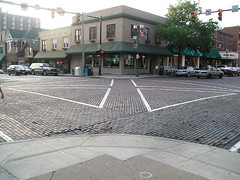
this would certainly be useful at that funky intersection of fulton and bridge in ohio city.
seven year old birkies
post seven years of intense use and nearly 6,000 miles of walking, and one resole later. these are the benchmark for all future shoe purchases. picked 'em up for $99 in a minneapolis shoestore. their replacements recently cost me nearly double at the shaker square everything birkenstock.
how much is seven years of dependable (and comfortable) service really worth??
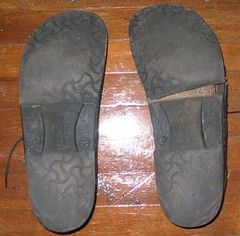
how much is seven years of dependable (and comfortable) service really worth??
Friday, February 04, 2005
my iPOD is better than you car stereo!!
Can you really DANCE in your car? Cuz I can get down in the streets or sidewalks. whatever it takes... in fact, I can keep on dancin right through the bus/train doors. while the train be movin, im groovin!
get out your damn car.....fool!
get out your damn car.....fool!
Tuesday, November 30, 2004
from the 'burbs of the great city of St. Louis
"The City of O'Fallon has approved a measure requiring provision for bicycle parking in commercial areas, office buildings, and schools:
Aldermen last week approved a new off-street parking law that, among other things, requires builders to provide at least one four-space bicycle rack for every 15 required parking spaces.
The law covers commercial, office, institutional, educational and recreational uses.
The city's Planning and Zoning Commission has required the bike-rack placements for a little over a year, said David Woods, the city's director of planning and development.
But the new law puts it in writing."
those four-space bicycle racks cost about $80 apiece and are popping up all over tremont....
Nov. 25, 1950. Euclid Ave. from E.79 St. to E. 71 St.

Monday, November 22, 2004
Good News for Cleveland and RTA!
Transit is Changing Look of the American Dream
"In Minneapolis and cities across the nation, public transit and the development it attracts are contributing to a growing appetite for housing in urban areas. Population groups that now have the deepest preference for housing very close to transit are precisely the populations that will grow exponentially in the next decades. They include older Americans, who will constitute 35 percent of our population by 2025; immigrant families, who will account for almost one-third of population growth; and the nearly 70 percent of households that will not include children."
Gee, we've already got the rail, running east and west across the city, woefully underused, largely because it doesn't go anywhere. Think about it, where can you go via the red, blue, or green lines? TowerCity, ShakerSquare, the southern edge of UniversityCircle, the inner harbor, and the Airport. All interesting places, sure, but what about the other 44 other stops?
Why is ridership low enough to justify only one car running during peak hours?
I'm going with numero dos.
Take a ride heading east on the redline from TowerCity and let me know what you see between dwntwn and universitycircle.
"In Minneapolis and cities across the nation, public transit and the development it attracts are contributing to a growing appetite for housing in urban areas. Population groups that now have the deepest preference for housing very close to transit are precisely the populations that will grow exponentially in the next decades. They include older Americans, who will constitute 35 percent of our population by 2025; immigrant families, who will account for almost one-third of population growth; and the nearly 70 percent of households that will not include children."
Gee, we've already got the rail, running east and west across the city, woefully underused, largely because it doesn't go anywhere. Think about it, where can you go via the red, blue, or green lines? TowerCity, ShakerSquare, the southern edge of UniversityCircle, the inner harbor, and the Airport. All interesting places, sure, but what about the other 44 other stops?
Why is ridership low enough to justify only one car running during peak hours?
- Because parking is cheap?
- Because there is little residential density near most stops?
- Because Clevelanders love their cars and hate public transit?
I'm going with numero dos.
Take a ride heading east on the redline from TowerCity and let me know what you see between dwntwn and universitycircle.
Sunday, November 21, 2004
bike parking as infrastructure
if only we had this much bike use and bike parking at my beloved cleveland state university. following the logic of building roads (which increases auto use), perhaps CSU could build some bike infrastructure ...?


Subscribe to:
Posts (Atom)